
Kneel down and look at your lawn at soil level and you will probably notice a layer between the green grass blades and the bare soil. It looks like a dense mat of beige or brownish material, a tangle of old stems, roots, and organic debris compressed just above the ground. A thin layer of this material, known as thatch, is a normal and even beneficial part of a healthy lawn. When it accumulates past a certain thickness, it becomes one of the most common and least-recognized causes of lawn problems across the greater Bucksport, Maine area. This post explains what thatch is, how to identify a problem, and what de-thatching involves.
What Is Thatch and What Causes It to Build Up?
Thatch is the layer of living and dead organic material that accumulates between the green grass blades and the surface of the soil. It is primarily composed of grass stems, crowns, and roots that decompose more slowly than leaf tissue. Despite what many homeowners believe, leaving grass clippings on the lawn does not cause thatch buildup. Grass clippings are mostly water and break down within a few days. Thatch is driven by the stems and root crowns of the grass plant itself.
The main factors that accelerate thatch accumulation include excessive nitrogen fertilization, which pushes growth faster than the soil microbes can break down the resulting organic material; overwatering, which reduces the oxygen levels in soil that soil microbes need to function; acidic soil conditions, which limit microbial activity; and certain grass species that are naturally prone to thatch. Kentucky bluegrass and creeping red fescue, both common in Maine lawns, tend to build thatch faster than tall fescue or perennial ryegrass.
How Much Thatch Is Too Much?
The general guideline used by turf professionals is: less than half an inch of thatch is normal, half to three-quarters of an inch is borderline, and anything over three-quarters of an inch is a problem worth addressing.
Testing your thatch depth is straightforward. Use a screwdriver or a soil probe and push it into the lawn. You will feel distinct layers: first the green blades, then a spongy or springy layer before you reach firm soil. That spongy middle layer is the thatch. Pull out a small section of turf, about three inches deep, and measure the brown layer between the green growth and the soil. This gives you a clear measurement without any equipment.
Another simple test is the feel of the lawn underfoot. A lawn with significant thatch buildup feels noticeably spongy or bouncy when you walk on it, similar to walking on foam. While some homeowners find this feel appealing, it is actually a signal that conditions below the surface are compromised.
Signs Your Maine Lawn Has a Thatch Problem
Water runoff after rain or irrigation: When thatch exceeds half an inch, it acts as a hydrophobic barrier. Water beads on the surface and runs off rather than penetrating to the root zone. If you notice puddles forming quickly or water sheeting off after rain, thick thatch is a likely cause.
The lawn dries out faster than expected: Counterintuitively, a thatchy lawn that repels water when wet also dries out faster. The thatch layer above the soil holds little moisture and dries in the heat and wind, while the soil below stays disconnected from rainfall.
Persistent brown patches: Brown areas that do not respond to watering or fertilization are often rooted, literally, in thatch. Grass growing in or through thick thatch develops shallow roots that cannot access soil moisture or nutrients effectively.
Fertilizer and treatments seem ineffective: When thatch is thick, granular fertilizers, herbicides, and pest control products may not reach the soil at all. They sit in the thatch layer and break down or wash away before reaching the root zone.
Recurring disease and pest problems: Thick thatch holds moisture against the crown of the grass plant, which creates ideal conditions for fungal diseases. It also provides shelter and a food source for insects and pest organisms.
Why Maine Lawns Are Particularly Prone to Thatch Buildup
Maine’s climate and soil create conditions that are especially favorable for thatch accumulation. Cool, acidic soils limit the activity of the soil microbes and earthworms that break down organic material. Maine’s soils are naturally acidic, and without lime applications to raise pH to the range where microbial life is most active (around 6.0 to 7.0), decomposition rates stay low.
The short growing season compresses the cycle: lawns grow hard from May through October, producing more organic material in that window than in milder climates, but with limited warm-season biological activity to keep pace with decomposition. Fertilization programs that push rapid spring growth without attention to soil health can tip this balance fairly quickly.
When to De-Thatch a Maine Lawn
The best timing for de-thatching in Maine is late summer to early fall, specifically from mid-August through mid-September. This window gives the lawn enough time to recover before winter, provides excellent conditions for overseeding immediately after de-thatching, and avoids the combined stress of heat and mechanical disturbance that makes summer de-thatching risky.
Spring de-thatching is a second option, typically after the soil has firmed up enough to work, in mid-April to early May. The caution with spring timing is that de-thatching is a stressful process, and doing it too early while the lawn is still recovering from winter can delay the season significantly. Fall is the preferred season for most Bucksport area lawns.
De-thatching should be avoided on newly seeded lawns. The process uses a power rake or vertical mower to mechanically tear through the thatch layer, and it will damage or remove seedlings that have not yet developed a strong root system. Wait until a newly seeded lawn has gone through at least one full growing season before considering de-thatching. See our post on new lawn seeding for more on establishment timing.
What the De-Thatching Process Looks Like
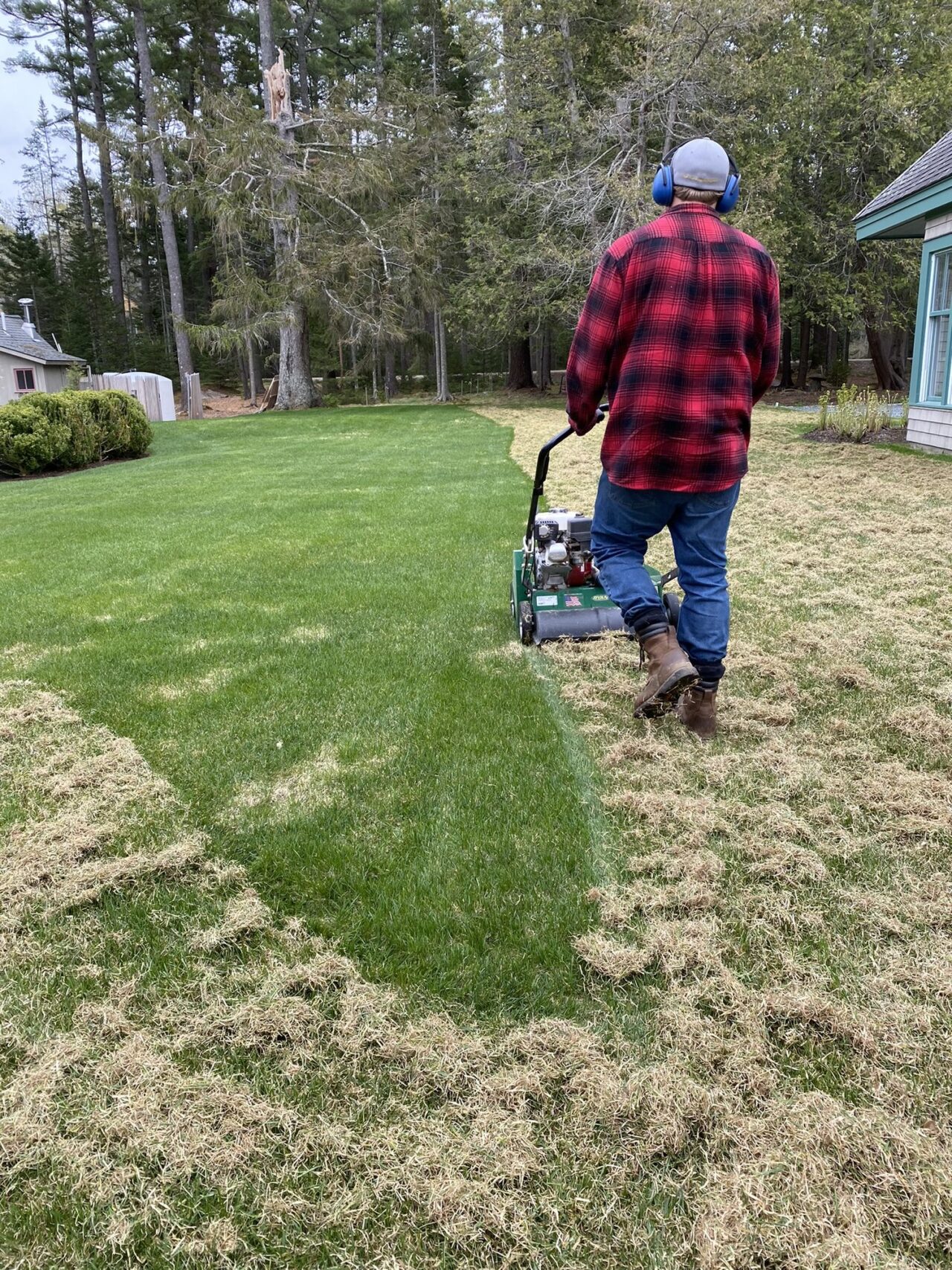
Power raking, also called vertical mowing or verticutting, is the standard mechanical method for de-thatching. The machine uses rotating vertical blades or tines set to a specific depth to slice through the thatch layer and pull the material to the surface. Multiple passes in different directions are typically needed to remove thatch thoroughly.
After the pass, the lawn looks rough and unsettling. Large amounts of debris will be sitting on the surface. This is expected and normal. The debris needs to be raked up and removed from the lawn. This often represents a surprising volume of material, which is itself evidence of how much thatch had accumulated below the surface.
The lawn will look thin and somewhat scalped for one to two weeks after de-thatching. This is also normal. The process removes material from the surface and disturbs the grass temporarily. Most lawns recover within two to three weeks, especially when followed immediately by overseeding.
What to Do After De-Thatching
Overseeding immediately after de-thatching is strongly recommended. The de-thatched surface, with its improved soil contact and reduced competition from thatch, provides excellent germination conditions. Select a seed blend appropriate for Maine conditions, typically a mix of fine fescues, perennial ryegrass, and Kentucky bluegrass. Keep the seeded area consistently moist for two to three weeks. A light fertilizer application at this stage supports recovery without pushing excessive top growth.
Core aeration is a natural pairing with de-thatching. Aeration improves water and nutrient penetration and introduces soil microbes that help prevent future thatch buildup. Doing both in the same fall visit is an efficient approach that produces strong results. A soil pH test is also worth considering after a major de-thatching project. If pH is below 6.0, a lime application will support the microbial activity that keeps future thatch accumulation in check. The University of Maine Cooperative Extension offers affordable soil testing and detailed guidance on lime application rates for Maine soils.
De-Thatching Services in Bucksport, Maine
Just Grass, Inc. provides professional de-thatching for residential properties throughout the greater Bucksport region and surrounding Hancock County communities. We assess thatch depth before recommending treatment and pair de-thatching with overseeding and aeration where appropriate for the best results. Contact Just Grass at 207-702-9074 or justgrassmaine@icloud.com. Visit our services page to learn about the full range of lawn care services we offer throughout the greater Bucksport, Maine area.